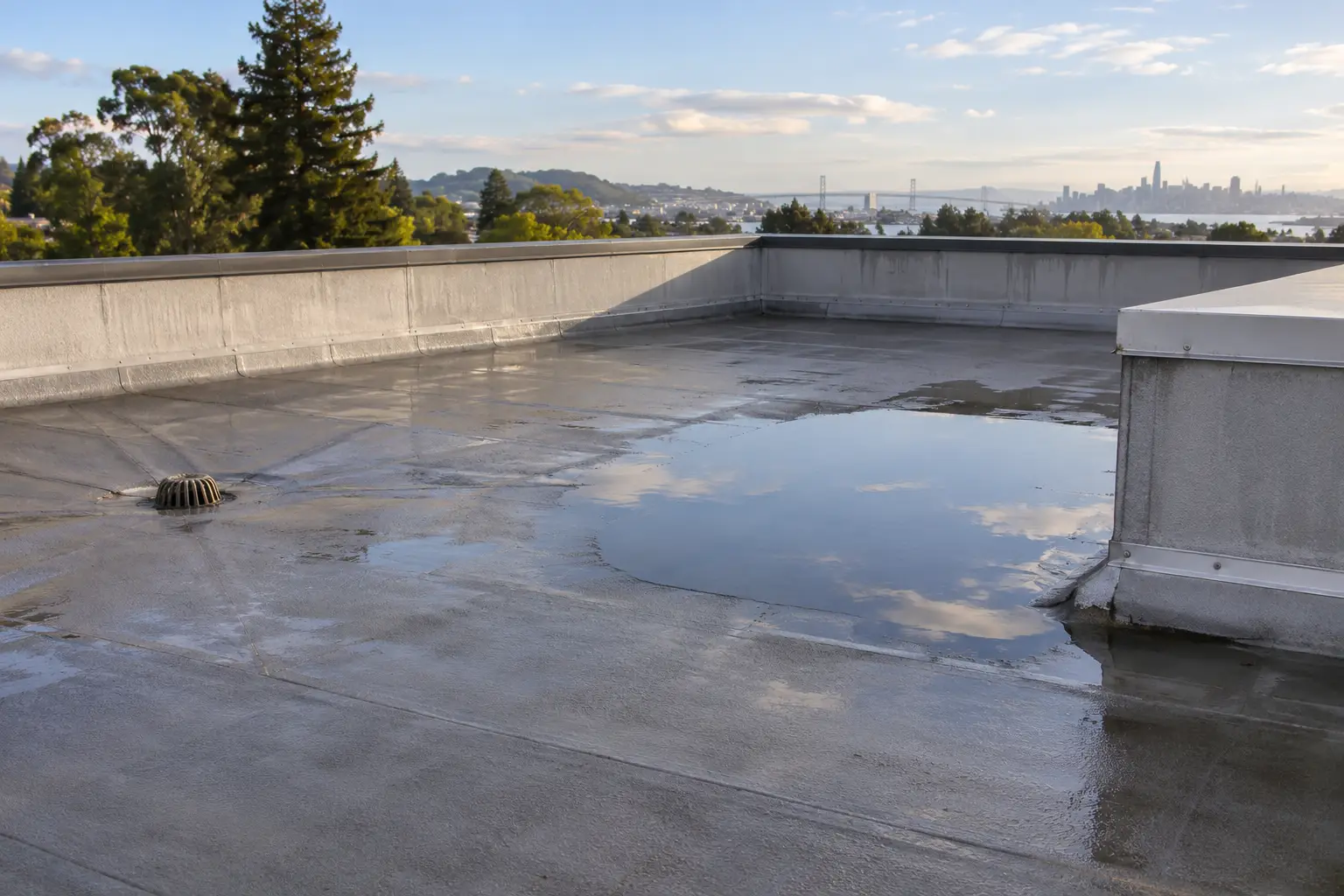

One brief shower and several days of repeated rain place different demands on a roofing system. Longer exposure can make patterns easier to observe, but it does not diagnose the source of water entry by itself. A complete replacement decision should connect observations with the roof’s materials, transitions, drainage, substrate, and history.
Repeated rain can expose relationships
Water may move across a covering, collect in a valley, meet a wall, pass a penetration, or reach a drain before leaving the roof. If one part is poorly integrated, the visible interior symptom may appear away from the exterior entry point. A stain directly below a surface condition does not always identify the full pathway.

Record patterns without taking unsafe risks
During active rain, high wind, lightning, flooding, or another hazard, follow official guidance and stay off the roof. Useful documentation can come from safe interior observations: date, time, room, ceiling or wall location, whether the condition changes with wind direction, and photos that do not require unsafe access. After conditions are safe, planning can connect those observations with the roof layout.
Drainage and slope shape exposure
Steep-slope roofs generally shed water across overlapping materials, while low-slope roofs rely on membrane continuity and planned drainage to drains or scuppers. Valleys, crickets, parapets, curbs, gutters, and edges influence how much water passes through an area and how long it remains there.
Transitions and hidden layers remain part of the story
Walls, chimneys, skylights, vents, pipes, and equipment curbs interrupt the field of the roof. Flashing connects them to the surrounding assembly. Underlayment and the deck also contribute, and some conditions remain concealed until tear-off. A replacement proposal should explain how discoveries will be photographed, evaluated, and authorized.
Compare the timing of the symptom with the roof layout
A condition that appears only during wind from one direction may point the planning discussion toward
a wall, edge, or penetration. A condition that develops after prolonged rain may involve a different path
than one that appears immediately. These patterns are clues, not proof. They help organize the field
review and replacement scope without assigning an unsupported cause.
Use the evidence to compare complete scopes
Each proposal should explain how the new system will address the relevant roof planes, drainage,
flashings, penetrations, underlayment or membrane, substrate preparation, and adjoining materials. If
proposals treat those components differently, ask why. The goal is not the longest material list; it is a
coherent system tied to verified conditions.
Build a replacement evidence file
- Create a safe interior log of dates, locations, duration, and weather direction
- Collect earlier roofing records, product information, and known project dates
- Map symptoms against roof planes, valleys, walls, and penetrations
- Separate verified observations from assumptions about cause
- Compare full replacement scopes for drainage, flashing, underlayment, and deck work
- Use the latest NWS Bay Area information for safety and short-range planning
Turn observations into a complete plan
NOAA seasonal outlooks show broad probabilities; they do not predict rain totals, timing, or roof
performance at a particular address. Imperia Roofing & Exteriors helps Bay Area owners plan
complete roof replacement and installation around verified conditions. When conditions are safe,
schedule an appointment to discuss a complete scope.
Recommended Internal Links
- Roof replacement service: https://imperiare.com/roof-replacement/
- Wet-weather campaign hub: https://imperiare.com/el-nino-wet-weather-exterior-preparation/
- Schedule an appointment: https://imperiare.com/schedule-an-appointment/